Showing posts with label writing tips. Show all posts

Sunday, February 8, 2015

The Common Problems With Sci Fi

 
Over the weekend I saw Jupiter Ascending. While I enjoyed it, I couldn't help but notice some common problems with sci fi, running rampant in this movie.

For a little clarity I'm going to give you a quick run down of the opening of the movie then use that to explain some common mistakes that occur in sci fi stories that don't quite work. See if you can spot some of the problems as I explain. And if you get lost in the explanation skip to the bold *** section and see why you got lost.

Meet the parents
The movie opens with a narration and meeting Jupiter's parents as they first find each other. Dad likes science and astronomy, Mom likes that he's crazy and into science. Fast forward, boom Mom is pregnant, and Dad wants to name the kid Jupiter. Mom says you can't name a kid after a planet, and then they get robbed in their own home. Dad tries to stop them from getting his precious telescope and gets shot and SPOILER **DIES**. At this point we aren't sure what this has to do with the story other than how our main character came to be.
Meet Jupiter
Fast forward some more and here's Jupiter. She wakes up at 4:45 am every morning, cleans toilets with her mom in fancy homes, and dreams of something more. Her life is boring and it sucks. YAWN. We get it Jupiter doesn't like things as they are, and feels like she should have more out of life.

Meet the sibling aliens
We are on some beautiful planet with tall shiny buildings and it's deserted. Oh wait who are those two? They are wearing fancy clothes and talking about inheritance. A third guy materializes out of mid air. One guy wants to make a trade and the other thinks it's cause he squandered his inheritance. They seem to tolerate each other and be related, but we don't know who they are, why we should care about them, or what they have to do with Jupiter who we just met.

Jupiter and her cousin
We know Jupiter wants nice things and can't afford them so she is getting her eggs harvested cause she wants to buy a telescope like the one that got stolen from her Dad. Her skeevy cousin has talked her into this and is using her for money. Again why do we care? What does this have to do with Jupiter and her story.
Meet more crazy aliens
We have some new crazy aliens with cool hair and tattoos on a roof watching another alien on the ground. Oh he's got cool boots, he's called a something or other that I never caught the name of. And oh hey, we can't let him live, but we won't tell you why.

Alien with the cool boots uses some cool tech to walk through a solid door into a fertility clinic to look at some records.

Aliens on the roof descend to the ground, one has a cool hover bike.

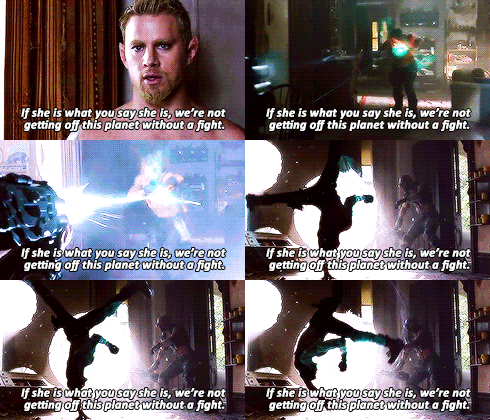
Alien with the boots emerges with a cool energy shield and they all fight in this epic fight scene with laser weapons and hover boots, but we aren't quite sure why.

Jupiter sees aliens
We've got some crazy lady Jupiter works for and cue the aliens mind probing the weird lady. Jupiter takes a picture on her cell phone that she later can't remember.
Crazy alien sibling wants someone dead
Cue crazy alien sibling number one. He wants what's rightfully his. What is that? We aren't really sure. He also wants someone dead. We aren't sure who said person is or why.

Jupiter goes to get her eggs harvested, uses a fake name
The aliens find her and scan her. She's the one, let's kill her! Cue crazy alien with the hover boots and she's rescued in some grand fight/chase scene. It's super cool. I SWEAR! But I still have very little clue as to what's happening to her or why.

Jupiter wakes up with alien
Every time he opens his mouth, it's to explain the world as he knows it, and to explain how everything Jupiter knows is only a partial truth. He was sent to rescue her by some guy and cue the info dump.

***
Are you still here or did you get lost? If you got lost, there's no shame. I saw the whole movie, and I'm still not quite sure I understand what happened. The problem is, by this point we are so far down the rabbit hole, I'd say at least 30 to 40 minutes deep in this movie, and we have nothing to latch onto. There's a million different story lines and characters, and very little grounding. But hey everything looks really cool! They are trying to build this amazing world with awesome tech, and keep secrets from the audience, but in the process all they have done is create confusion and little connection to the characters. And spoiler, as the movie goes on every time an alien opens his or her mouth, there's more giant dumps of information.

So what went wrong?
Cool Scenery
Hey everything was gorgeous, visually stunning in fact, but none of it seemed to have any point in the story. In fact sometimes we had no idea what planet we were on or why it mattered. It very often gave the audience a "why are we here" and "why should we care" feeling.

Cool Tech
What is sci fi without cool tech? I love fun things like hover boots, hover bikes, and energy shields. But if it's just floating around early in the story to say hey this is different than the world we know today, and it doesn't seem to fit with in the context of the story, it will probably confuse your readers. Put the cool tech in by all means, but at least make some of it serve a purpose with the plot and/or characters.

Character Development
Sometimes we get so excited about sci fi and all the possibilities that we forget the reader needs to connect with our characters. We can throw cool characters in there, but if we have no reason to care about them or connect with them from the beginning, we as a reader are going to give up and move onto something else.
Dropped in the Action
Fight scenes, yes they are cool and full of action and excitement. The problem with them is, if they are done incorrectly, you feel dropped in the middle. Even worse when there's crazy tech and characters the audience doesn't care about, this creates chaos and confusion. We get those, "who are these people", "why are they fighting", and "why should we care" feelings. If you are going to have an action sequence or a cool fight scene make sure the reader is grounded in it so they know why the parties are fighting, and why it's so exciting.

Back Story
This is a common problem in a lot of books not just sci fi. That said, in Jupiter Ascending did we really need 20 minutes of movie to explain how Jupiter's parents met, how she came to be, and that her life sucks cause she cleans toilets? Nope. Sure it told us she had money problems, wanted greater things for her life, and got her to the clinic where she was attacked by aliens, but a much more interesting story may have shown Jupiter's struggle with money in some fun way and let the dad's telescope thing come out a little more organically.
Show vs Tell / Info Dumps
Now I put these together because they seem to go hand in hand. While sci fi can have slightly more telling than say a contemporary story, there still needs to be a balance between show and tell. There are ways to show different worlds, alien species, and what they are all about without telling the audience everything about them. And if every time an alien opens his or her mouth it's to dump a million pieces of information on the reader, then you are just going to overwhelm them with weird names, facts, and plot with a lot of unnecessary back story. So there needs to be a way the reader can be informed of the important information organically and gradually. It needs to be woven seamlessly throughout the story instead of like word vomit on the page.

All that said, Jupiter Ascending had a lot of potential. And if you take it for a visually stunning movie with some cool ideas then you will enjoy the movie. If you rip it apart for it's many plot problems, you may not like it as much. I found myself having to turn my brain off at times and just enjoy the pretty scenery and awesome technology. So if you write sci fi, use this as a lesson to create cohesive, exciting sci fi with awesome characters and a kick ass plot that unfolds before the readers eyes and entices them to keep reading.

Saturday, January 4, 2014

Advice - The good, the bad, and the ugly!

There's a lot of people in the writing world claiming to be experts. Many are. But there are equally as many that aren't. There's also a lot of people who want to offer their advice and opinions. By and large most mean well, but unfortunately there's quite a few people out there who either don't know what they are talking about, or they can only talk to their specific situation and experience. The latter isn't always a bad thing, but it also doesn't make the person an expert on all things writing, editing, and publishing. It makes them an expert on their individual process.

So when it comes to writerly advice, we as writers really need to do our homework. There's some awesome advice out there, but how do we find it? And how do we know if it's really sound advice we should follow?

Research
Google is your friend! Go to sources - publishers, agents, editors, national writing organizations like SCBWI etc. Even still not all publishers, agents, editors etc. are created equal. Just because someone says they are an agent, editor, publisher, doesn't mean they are a good one with good advice. If you can't find anyone else willing to back up the advice you're seeing, be wary of it. There's also wonderful sites like Preditors and Editors that list agencies, editors, and publishers and state whether they are reputable or not.

Get a second opinion
Just because someone says something doesn't make it true. I don't care what part of the publishing process they are in, they may be misinformed or have been given bad advice themselves. Talk to as many people as possible. Get a wide range of opinions before you make a decision on whose advice to follow.

Understand what you are signing
If there is any sort of contract involved READ IT! Read every single word, read it till your eyes bleed, and read it until you have it memorized. If you don't understand something, ask your agent, or higher a lawyer or other professional to explain it to you. Make sure you understand what you are responsible for, how this deal will benefit you, what kind of rights you are signing over, and what each party is getting from this deal.

Ask questions
If you aren't sure about something, ask questions until you feel comfortable with it. There's no such thing as a dumb question so don't be afraid to ask. If someone refuses to answer a question it may be a red flag. But if you aren't sure about something ASK!

Go with your gut
If all else fails go with your instincts. If something feels off then it probably is. If it seems too good to be true, it just might be. There's a lot of people out there looking to take advantage of writers, so be vigilant and trust your gut.

By in large there's a lot of great advice out there online, just make sure you really look into it before you leap and rush into a decision. You'll save yourself a lot of headache in the long run if you take your time and do your homework.

Does anyone else have any suggestions on how to vet the good advice from the bad? Feel free to add them in the comments.

Thursday, October 10, 2013

Murphy's Laws of Writing

Anything that can go wrong, will go wrong. And I'm not just talking about the bad things you do to your characters. Welcome to writing! Murphy is a little pain in the rear and he will strike when you least expect it! So make sure you learn his laws as they apply to writing.

Murphy's Laws of Writing:
1.) You come up with a really cool idea... YAY shiny... only to discover it's been done a million times. Not so shiny anymore is it?
 
2.) After making a command decision to take your story in a certain direction, you commit the words to your draft. Only then does a better scenario present itself.


3.) You write in a side character only to later discover you don't need him/her.

4.) Halfway through a draft you'll learn something really valuable about your characters and/or plot that would have helped you from page one.
 5.) You give advice to a critique partner and days/weeks later discover that you should listen to yourself more often.

6.) That line you thought was really cool... yeah now you're cutting it. Either that or you're making it completely unrecognizable in edits. 

7.) You'll write something absolutely brilliant. The next day you'll wonder what the hell you were thinking.


8.) Find/replace is your best friend... until you realize it's become your worst nightmare.

9.) Corners aren't just for bad children. They're for plots too!

10.) Writer's block is not a myth. It's a reality. And it will strike at the most inopportune time. Especially when you have a deadline.

BONUS: After you send a query/manuscript to an agent/editor you'll find a typo, several if it's a manuscript.

Have any others? Feel free to add them in the comments.

Monday, September 2, 2013

The Harsh Reality of Querying

I've been kind of quiet lately on Twitter about my writing and things going on. And it's because I've been pretty down lately. Okay not just down, I've been a miserable wreck. Honestly I hesitated to write this post because as writers we are often told it's best to keep quiet. We shouldn't talk about requests, rejections, or being out on submission. If we are feeling down we shouldn't blab on twitter, because that is something we should keep behind closed doors. So that's primarily what I've been doing because we aren't supposed to look crazy in public; even though everyone knows writers are crazy. But I've come across some hard truths that I thought I should share with everyone.

Querying is hard. No not just hard, it's soul sucking torture at times. I honestly never anticipated how gut wrenching it would be. I did my research before I even sent out my first query. I didn't make any of the standard rookie mistakes, I got critique partners, I workshopped my query, and I followed all the major do's and don'ts of querying. I figured because of this I'd have a little easier time in the querying trenches.

Boy, was I wrong.

Just because you studied what makes a good query letter, does not mean you will instantly get requests. And even though you may know what makes up a good query letter, it doesn't mean you wrote one. In fact you may get form rejections just like everyone else who does make those rookie mistakes. And that could be for a variety of reasons.

You aren't standing out in a crowd
So you had an awesome idea, you wrote a book, and you edited and polished it until it was ready. Now you're querying. So what makes your book different from every other book out there with a protagonist that has superpowers or is a ghost, or just discovered there's a secret world within their own? You may think you're idea is great and so different than anything out there, but if you aren't conveying that clearly in your query, an agent is most likely going to pass and may not even read your pages. Harsh? Yes, but it's the truth of matter.

Subjectivity
Again you may have an awesome idea, and the agent may even look at the query and agree. But then they get to your pages and they don't connect with the voice, or the character or think you started in the wrong spot. There's any number of reasons an agent may pass and it may be because they personally just don't get along with your work. They don't love it enough to want to read your book a million times and that's what it takes.

Your query is too long
A lot of agents skim queries. It's seems unfair that you put countless hours into perfecting your query and an agent just spends half a minute on it. But the reality of the situation is, agents get anywhere from fifty to several hundred queries a week. And queries, are unfortunately at the bottom of their list of priorities. They read them in between working with their clients, trying to sell books, negotiating contracts, and numerous other things.

While agents love new clients, they have to take care of their current ones first. So when they open a query that looks long, they are probably just going to start skimming. Think about it, when you open a webpage or blog that has a lot of words, you skim too. So why would an agent who has a million other things to do take the time to read your six paragraph query? They aren't, unless they find something that piques their interest.

In fact, even if your query is short, they may have only a few minutes so they may start skimming. So do yourself a favor. Make your queries short, and to the point. Make your sentences snappy and pack a punch. Do everything in your power to make your book stand out in as few sentences as possible while highlighting the voice of your story.

Honestly that right there is where I'm getting hung up. It's not easy to paint a clear unique picture about your book in a few short voicey paragraphs that grab someone's attention. So even if you are doing everything they say in the do's and don'ts you still have a lot of work ahead of you. The harsh reality is just cause you're ahead of the pack and not making "rookie" mistakes doesn't mean you're where you need to be in the querying trenches to catch an agent's eye.

But I didn't write this post to scare anyone. I wrote it to put the truth out there and to talk about my experiences and lessons learned. I wanted to let other writers know they aren't alone in the querying trenches and it's okay to feel down. I'm right there with you! If you are getting requests pat yourself on the back. It's quite an accomplishment. And if you aren't, maybe it's time to take a step back, look at your query, and re-evaluate. I know it's been eye opening for me.

Thursday, August 22, 2013

Finding the Strength


We all feel it-that nagging voice that tells us we aren’t good enough, that we have no idea what we’re doing, and that we’re wasting our time. That little voice, or even person, that says you can’t do this no matter what you do.

It sucks; especially when you want something more than breathing air.

So how do you pick yourself up and keep moving forward when you feel like you’re at the bottom of a million foot cliff with no way out?

Well, you have two options. You give up or you pick yourself up and find a way.

But how do you do that when your head keeps telling you how much you suck?

There’s been a lot of talk on the #keepgoing hashtag which is motivating writers to not give up. To do exactly that, KEEP GOING! It’s inspiring to see writers making it and achieving their goals. Even to see the difference one year makes.

Most of the time.

But sometimes those gremlins get in your brain and make you feel like you’re a slacker compared to the rest of the community, that you aren’t working as hard as the rest, and that you just can’t live up to everyone else.

You tell yourself you’re too fast, or too slow, or aren’t on the right path or any other host of things that eat at you from the inside out. You tell yourself you aren’t where you’re supposed to be.

I’ve got news for you…

THERE IS NO RIGHT PATH

YOU ARE EXACTLY WHERE YOU SHOULD BE

There’s only the path you are on and what works for you. Do what helps you learn and grow in the way that you need to in order to accomplish your goals.

Do what you have to do!

Plain and simple.

Find a support system, hone your craft, work at your own pace, and don’t give up. Only you know what’s right for you, so don’t let anyone else tell you otherwise. Have faith in yourself, and stick with it!

Thursday, August 8, 2013

You Can’t Please Everyone… So Stop Trying!


Ever feel like you are being torn in two trying to please everyone? Yeah that’s me pretty much every day. And it seems to be happening more and more lately. Someone has hold of each of my arms and legs and they are just pulling until I’m busted at the seams.

Okay, well that’s really just a metaphorical me, but it seems like it’s happening with increasing frequency when it comes to my manuscript. One person says one thing, someone else says something completely contradictory, and my head is spinning so fast I look like I need an exorcism. But that’s the thing, just because someone gives you advice, doesn’t mean you are obligated to take it. It is merely that, advice, someone’s opinion.

Writing is so subjective. It’s often difficult to know what feedback to listen to and what to ignore. So how do you know if you are making the right decision? Because you can’t possibly please everyone.

But that’s just it. There is no right decision, at least not in the general sense of the phrase. There is only what is right for you and your story, and what your gut tells you. It’s so hard to follow your gut. But you and only you know your story best, so you have to be true to that. By all means take what resonates with you and let your story evolve. But at the end of the day, you have to be happy with your story first or no one else will. Everyone else will either choose to stand behind you or not. Revel in those that support your vision and don’t sweat the others. Because unfortunately you can’t please everyone, so stop trying!

Give yourself a break. You’ll be better off for it.

Monday, July 22, 2013

Why Each New Book Seems Harder to Write


I never thought the second book I would finish would be harder to write than my first. But now that I've started another draft and it's even more difficult than anything I’ve done before, I often wonder why writing more and more books seems to get harder rather than easier. Of course certain aspects are easier, I know what cliches to avoid, what words to stay away from, how to show not tell and basically how to avoid the "rookie" writing mistakes. But the actual writing of the book, the completion of the draft seems to get increasingly difficult. So I started to think about why that is and came up with the following reasons:

Constantly stretching oneself.

As writers we strive to do better. Our goals get bigger, which means we tend to take on harder more complex concepts as we go. And with those bigger goals the mind often struggles to keep up. We start to wonder if we are reaching too high, if we’ve gone outside the realm of our capabilities. If we are in over our heads. All these questions can cripple the writing process, which leads directly into the next issue…

Self-doubt.
The more we write, the more the brain starts to catch up. The worry increases. We wonder can I really do this again? What kind of mess have I gotten myself into this time? Even worse, we think the rest of the world will discover the truth about us—that we have no freaking idea what we are doing. How long can we really fake it, and when will someone stand there with their finger pointed at us saying haha I caught you? The whole idea is completely daunting. All the self-doubt then leads to undue…

Pressure.
Naturally the more we write the more we expect ourselves to improve. In fact, so do our critique partners and our readers. Constantly getting better is important but it's also exhausting. And the thoughts that we constantly have to be better creep into the mind when writing that first draft. Which makes it ever so difficult to write and even harder to finish. We as writers have to step back and re-allow ourselves to have shitty first drafts. We are allowed to suck, and once we remember that it relieves some of the pressure. But with that pressure also comes the drive to…

Strive for uniqueness.
They say every person has a book in them. And in many ways that first book is easy because the ideas just flow. Not that finishing is easy, in fact finishing my first book was the most difficult thing I’d ever done. But the more books we write, the more we have to pay attention to what we've done in the past, and continue to strive for something new and different. We don’t want to keep writing the same characters in new settings or new characters in the same situations that we've written about before. We want to write new characters with new stories and our readers want the same. We need to continue to push ourselves, but again it’s exhausting.

The good news is, we as writers aren’t alone. We all go through this. And once we diagnose the issues we are having, we can usually get right back into a draft. We can continue to better ourselves as writers and stretch our limits beyond what we thought possible.

So what are some of the things that make your writing more difficult and what do you do to carry on?

Tuesday, May 21, 2013

Got Voice?

Voice is something that a lot of writers struggle with. I know I did, and still do sometimes. No, I'm not talking about those voices inside your head that won't shut up until you put them on paper. Although, they can be helpful, when they aren't driving you to insanity. But how do you really understand voice? In the past I spent a lot of time searching the web for a clear and concise definition of voice. Sadly, I always came up empty. I could never find a good description that made sense to me. And that's because voice is so tricky. Voice is one of the most subjective parts of writing, because the definition of voice is different for every reader.

So how do you know if your writing has voice? The short and blunt answer to that question is, if you are still asking, you probably haven't found your voice yet. When you find it you know. It's not just a feeling in your gut but everything starts falling into place. It makes sense and everything feels right. But if you aren't sure yet that's okay. There are things you can do to draw out your voice.

1.) Start with someone else's writing
When you read something and it's dripping with voice, you just know it. But what is it about that piece that makes you notice? Sometimes it's the language used, the dialogue of the characters, or just some quirkiness or distinct feature to the writing. But voice really goes deeper than that. It's the essence of everything you write. Your voice can come down to the very words you choose and the manner in which you string them together on the page.

2.) Listen to those voices
Remember those voices I mentioned at the start of this post? The ones that make you feel like a crazy person? Yeah those! Listen to them. Let them speak through you. Allowing those crazy voices to take over helps form your voice. Pay attention when that happens and try to apply it throughout your writing.

3.) Search your manuscript
So how do you find your voice when you aren't sure? This can be tricky. But after finding mine, I'm a firm believer that it's hiding in your manuscript somewhere just waiting to be discovered. Yes somewhere in your manuscript is a scene just oozing with your author voice. You just have to find it. Odds are it's not your first page or even in your second, third or tenth, but it's in there. So where do you look?

Think about your main character, what's important to them, and what defines them as a character. Then find a scene in your manuscript where they are doing one of the following:
  • Engaging with a close friend
  • Engaging in an activity that is really inside their comfort zone
  • Engaging in an activity that induces stress or tension
  • Engaging in a scene far outside their comfort zone
  • Engaging with the enemy/antagonist
In the first two bullets your character is in their element. The main character is comfortable to act like his or her true self. In situations like this their voice is likely to speak loud and clear, sometimes it even screams. If you can find a scene like that, it shows your character in their natural environment and how they respond in day to day situations.

On the flip side, the last three bullets take the character in the complete opposite direction. It's a situation or event where your character doesn't have time to think and their true colors can really show, meaning their voice is likely to be louder then as well. Taking a character out of their element allows them to really shine or fall flat on their face. Either way they will usually do it in a very distinct way with specific words that define them completely.

4.) Read it and read some more
Once you find that magical place where your character is screaming loud and clear in his or her natural voice then you need to read that scene. Then read it again and again and again. Get a good feel for the voice in the scene, why it's coming out so clearly, and why it works. Hold onto that scene tight, you'll need it in the future.

5.) Apply
Now that you've identified your voice and have a good understanding of it, go back to the beginning of your book and rewrite the scene using the newly discovered voice. Often times it doesn't require large rewrites but small changes that pull the character's voice to the surface. Use the language the main character would use and let their thoughts and feelings seep onto the page.

By this point your gut should be churning because everything should start falling into place. If you are still struggling don't despair. It happens to a lot of us. See if you can get a trusted critique partner to take a look at your manuscript and identify some scenes that have great voice. Then use those as a guide to rework the rest of your book.

Your voice is there, now go find it!

How would you define voice? Are you struggling to find yours? Do you have any good tips on voice or blog posts to share? Let me know! I'm always curious to learn more.

Wednesday, May 15, 2013

5 Tips for Stress Free Pitching


Last month I attended the Missouri Writer’s Guild Conference and pitched to agents in person for the first time. I was terrified. We aren’t talking a little stage fright here, I mean full on knees shaking, I think I’m going to puke, terrified. I ran around for weeks prior to the conference freaking out about my upcoming encounters with the agents. The funny thing was I’d been to a conference before, I’d met agents, and it wasn’t a big deal. But this time felt different. I was going to be putting my manuscript out there in the world. What if I didn’t do it justice? What if the agents hated it?

As the conference approached I nearly talked myself out of pitching. Nearly. But there were a few things that helped make the pitch process less painful.

1.) Practice Makes Perfect
Practice Practice Practice. When you are going to give a speech or a presentation what’s the one thing you almost always do? Unless you're the kind of person that likes to “wing it,” and that’s not me at all, you practice. When you're going to pitch an agent you should do the same thing. Spend some time constructing a pitch and then practice it like you are having a conversation with someone. I practiced in the shower, in the car, in front of the mirror, to my dog, and even pitched to fellow writers. So help remove the nerves from the equation and know what you are going to say ahead of time. The more you say it the more naturally it will roll off the tongue, and the more excited you can sound about your work.

2.) Meet the agent first
As a shy introvert I hate meeting new people. I never know what to say and I always feel like I’m an awkward, bumbling idiot. All of those feelings stem from the fact that I fear the unknown. I’m a giant control freak and when I can’t control a situation I start to panic. When you meet someone for the first time there are so many unknowns, which is why I feel so awkward around new people. So for me, taking the unknown out of the picture is key.

In this case, the unknown is the agent that you may have followed on Twitter forever but have never met in person. While you may have some idea of their personality from online interactions (or stalking – don’t lie I know we all do it!) that isn’t always a guarantee of how they will act in person. So if you can, find a good time (yes the “a good time” is important) to introduce yourself to the agent. If you can sit at their table at lunch, catch them after a seminar they gave, or volunteer to shepherd them, those are all good ways to take five minutes to say “Hi I’m so and so, it’s very nice to meet you, I’m glad you’re here.” You can even mention that you liked their seminar or possibly say I’ll be pitching to you later or tomorrow but keep the exchange brief.

Keep in mind, this is not the time to talk about your book or even mention your writing (unless they ask), just meet them. You don’t walk up to random people and start pitching your book, so don’t do this to an agent. From this brief encounter you should be able to tell that the agent is probably pretty nice and not some crazed, axe-murdering psycho setting out to ruin your writing career. See agents are people too!

3.) Don’t worry about being perfect
Now that you’ve practiced your pitch and met the agent, you’re hopefully a little less frazzled and ready to pitch. It’s going to be perfect! But what if it’s not? What if you mess up? What if you forget something? What if… Yeah stop right there. You can what if yourself to death and drive yourself crazy. I know I did. The good news is you don’t have to be perfect and shouldn’t try to be. You know why? The agent doesn’t know your book, they don’t know what you‘re going to say, and they don’t know what you practiced. So if you mess up, the only person who will know is you. Unless you have a really bad poker face like I do. So take a deep breath, calm down, and don’t sweat the small stuff. Give yourself permission to pitch well but not perfect.

4.) Treat it like a conversation with a stranger
Stranger or friend, when people find out that you write, what is usually the first thing that comes out of their mouth?

The encounter usually goes something like this:

Stranger: So what do you do in your free time?

Writer: Free time? What’s that? I spend most of my time writing.

Stranger: Really? That’s so cool! What do you write?

Writer: Middle Grade and Young Adult science fiction mostly.

Stranger: Wow that’s neat what’s your book about?

I’m going to stop the fun, little scenario there because the next thing out of your mouth should be a quick concise couple sentence description of your book. I know writers love to talk about their books, I do as well, but if you go on much longer than a few sentences you risk boring the stranger to death or losing their attention in some crazy long description that they won’t follow. But if you choose your words wisely, the next thing that will come from the stranger after your description is some kind of comparison or question about your book. Something like ohh that’s cool so kind of like X book or movie, or cool, so what happens next?

Now go back to the little scenario and replace the word stranger with agent. Congratulations you’ve just pitched an agent. I just let you in on a little secret that saved me at the conference—the realization that pitching to an agent is no different than talking to a stranger about your book. You’re hoping that they want to know more and one day want to read some of it. If you can keep the agent engaged and get them asking questions you are on the right track. If they ask to read some, you are in. The goal of the pitch is to get the agent to request pages. Plain and simple. So if you can grab their attention and keep them interested, you’ve pitched well.

5.) Realize you have nothing to lose
This one is big. When you walk up to the agent to pitch where are you at? They know nothing about your book, they haven’t read it, and don’t know you exist.  Harsh but true. So if you pitch to the agent and they say no, where are you at then? Well they know who you are, what you write, what your book is about, and that it’s not right for them. So what did you lose? Nothing, in fact if nothing else you met a nice person in the industry. So even if they say no, you are ahead of where you were when you started. And if they say they want to see part of your manuscript even better you’re one step closer!

There you have it, nothing to be so nervous about. Agents are people too, they are nice, and they want to hear about your book, because guess what? They love books! So don’t sweat it! 

So do any of you have upcoming conferences where you will be pitching in person? What scares you the most? Have you pitched in person before? What tips do you have?